
Kashf for UBL: identity verified in seconds
The art of smart verification: AI-powered KYC and identity checks, implemented for United Bank Limited.
- scan the ID, prove liveness, match the face
- 3 steps
- accuracy on Smart CNIC cards, in testing
- 98%
- accuracy on Urdu CNICs, in testing
- 92%
- face verification accuracy, in testing
- 97%
As banking moves online, one question matters more than ever: is the person on the other side of the screen who they claim to be? Kashf answers it in seconds. It scans a government ID, checks that it is genuine, and confirms that the person holding it is real, present and a match for the photo. FetchSky built Kashf and implemented it for UBL, one of Pakistan’s largest banks, to bring secure, simple identity verification to its digital channels.
In short
- Kashf is an AI-powered KYC and identity verification solution built by FetchSky and implemented for United Bank Limited.
- Kashf verifies a customer in three steps: it scans and authenticates the ID, checks liveness with random head-movement prompts, and matches the face on the ID to the live video.
- In testing, Kashf achieved 98% accuracy on Smart CNIC cards, 92% on Urdu CNICs and 97% on face verification.
The challenge
What needed solving?
Digital convenience brings the risk of identity theft and payment fraud, with serious consequences for customers and for banks. Fraudsters adapt as fast as the technology does, exploiting weak points in digital systems, and traditional identity checks are no longer enough to stop them. UBL needed verification that is both stronger and easier to use — a solution that could:
- Meet KYC requirements and support compliance with anti-money laundering regulations.
- Speed up onboarding by reducing manual document checks and paperwork.
- Resist fraud, including forged documents and attempts to fool face recognition with photos or videos.
- Fit the bank's own systems and policies, including its core banking platform and deployment preferences.
Our solution
How does Kashf verify someone?
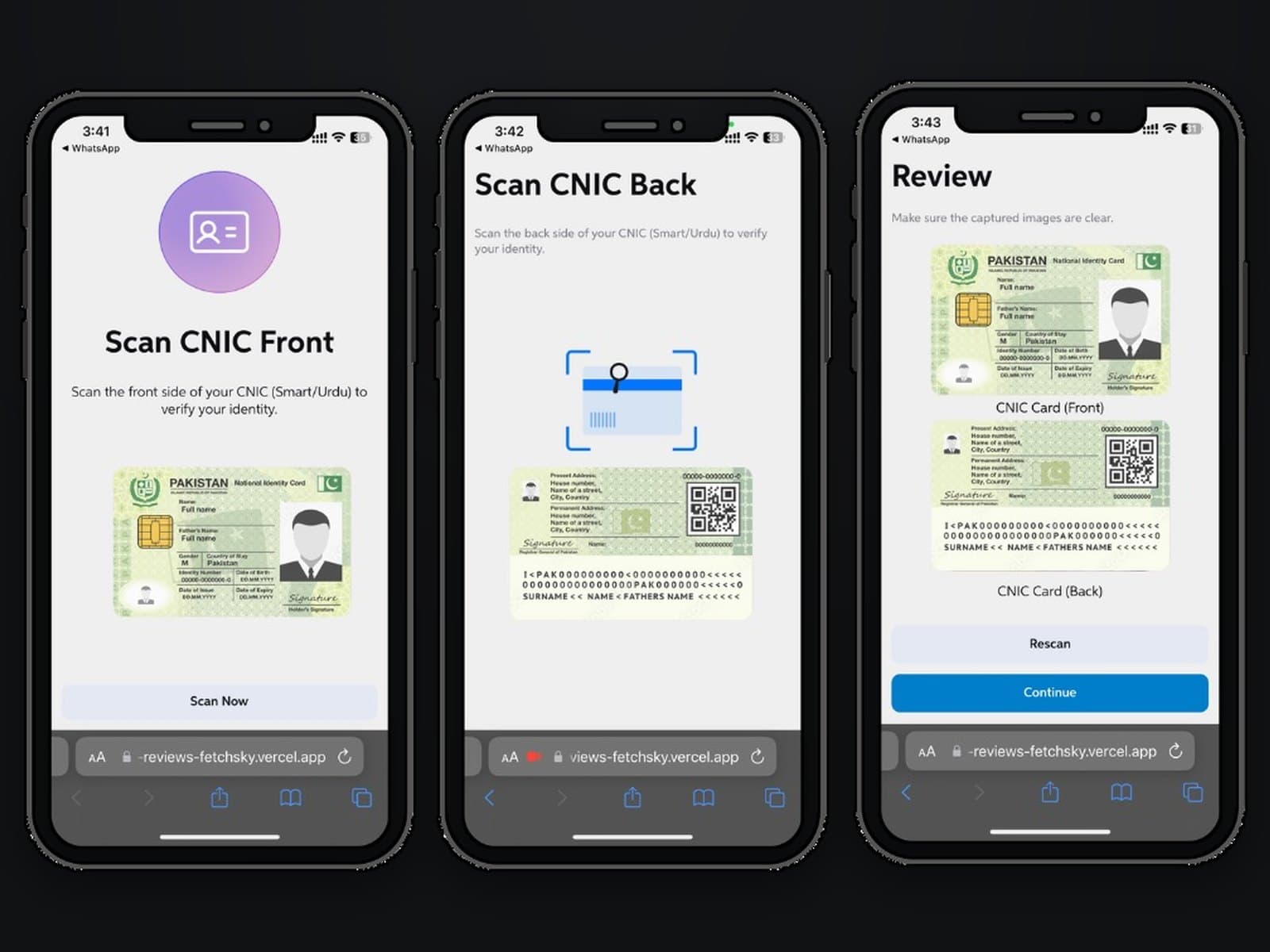
Three guided steps on the customer's phone: scan the ID, prove they are live, and match the face.
Three steps
The camera opens with an on-screen guide showing where to place the CNIC, and real-time prompts to move closer or further away until the card is in focus. Kashf recognises whether it is seeing the front or the back, captures both, and lets the customer review the captures before going on. As it reads the card, AI checks watermarks and security features for signs of tampering or counterfeiting.
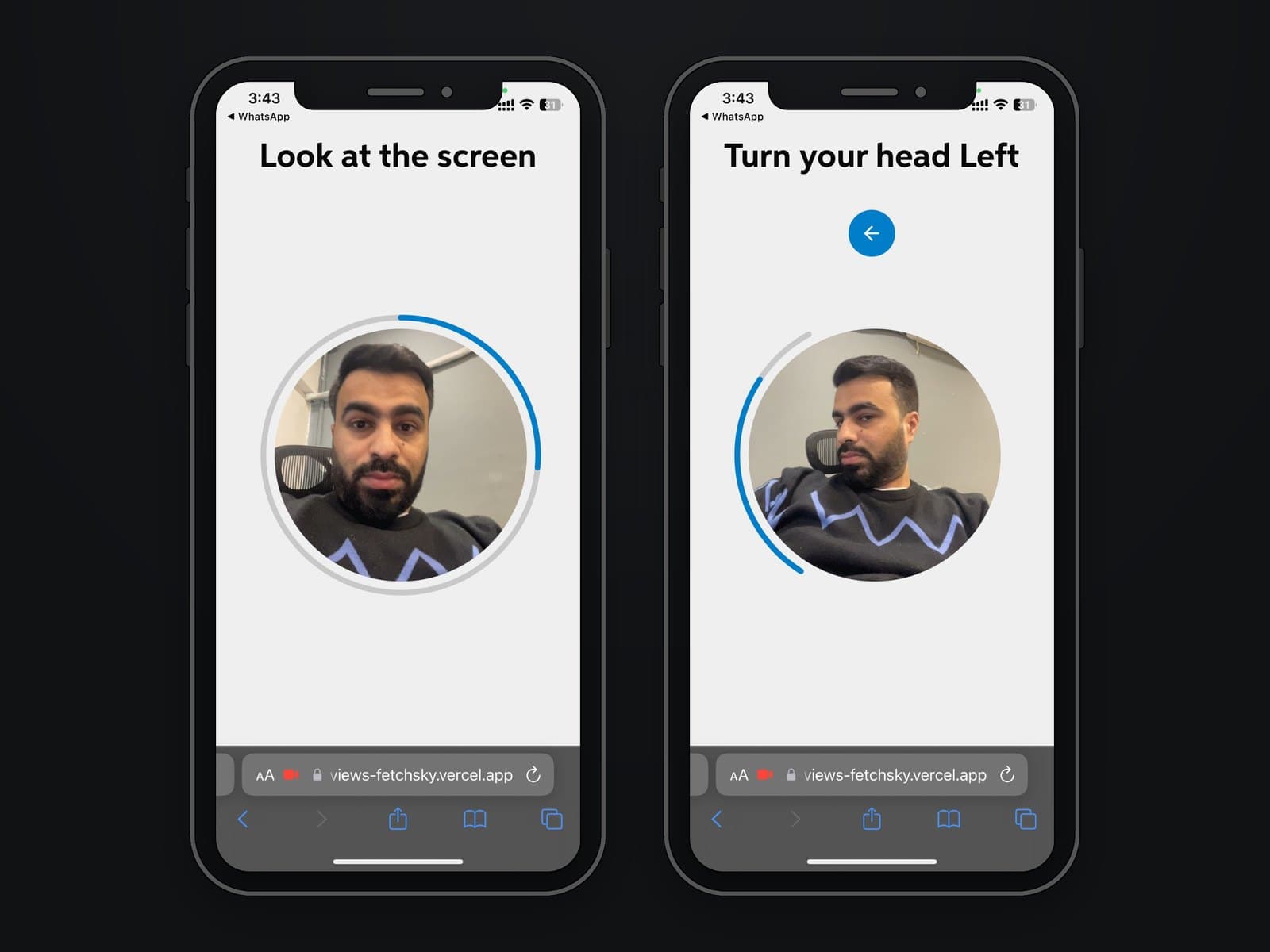
The customer looks into the front camera and follows prompts generated at random — turn your head left, right, up or down — while Kashf tracks facial movement and expression. Because nobody can know the prompts in advance, a photo or a recorded video of someone else cannot pass.
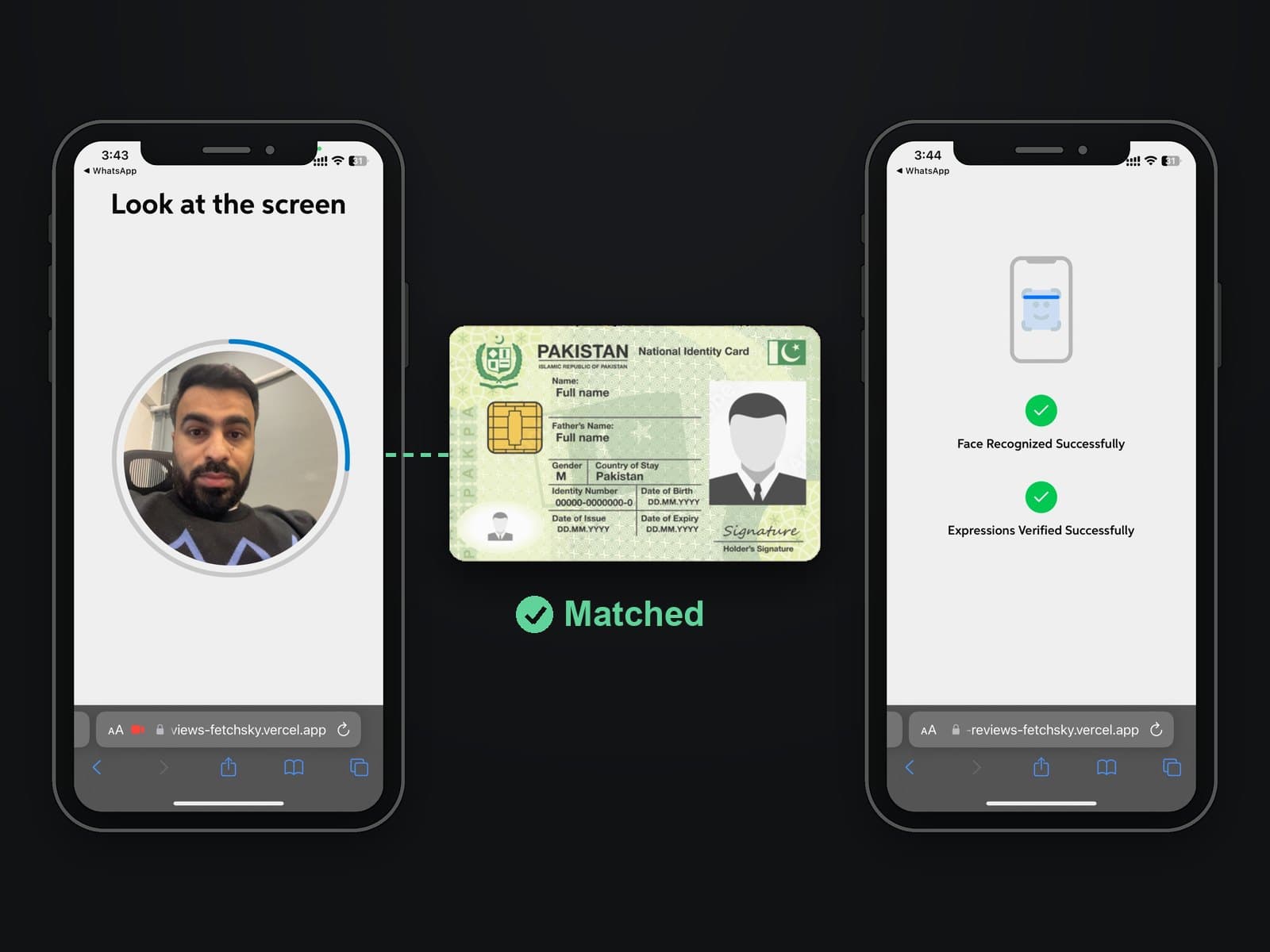
Kashf cross-checks three things together: the face on the ID against the live video, the gestures performed against the ones it asked for, and the authenticity of the document. The customer is verified only when all three agree.
Key capabilities
Fast and guided
Real-time processing and clear prompts keep onboarding quick and smooth, without sacrificing accuracy.
Fraud prevention
Real-time document validation, forgery detection and gesture recognition reduce the risk of fraud.
Integrations
Connects with core banking, CRM systems, government databases such as NADRA, and AML and PEP screening databases.
Customizable
Verification parameters, document types and interface elements can be adjusted to industry needs and regulatory requirements.
Flexible deployment
Run it in the cloud for scalability, or on-premises for enhanced security.
Accuracy
In testing, Kashf achieved 98% accuracy on Smart CNIC cards, 92% on Urdu CNICs and 97% on face verification. Results depend on dataset quality, the style of ID, image quality, lighting and the condition of the card.
What does Kashf read from a CNIC?
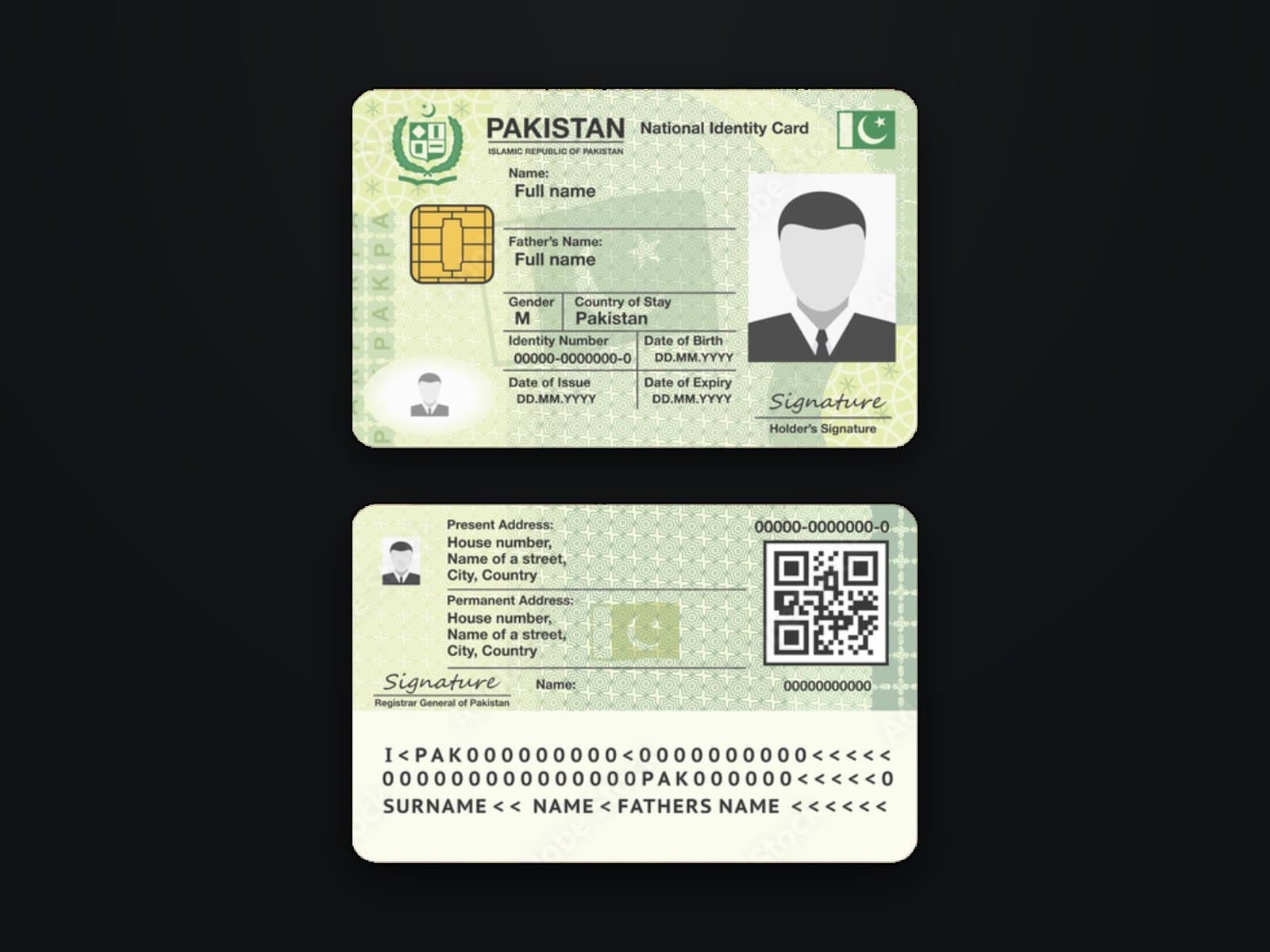
From the front and back of the card, Kashf extracts:
- The face image
- Full name
- ID number
- Date of birth
- Document issue date
- Addresses
- The QR code, which carries the ID number
Reading is only half the job. In the same pass Kashf checks the card’s watermarks and security features, so a forged or altered card is caught before the selfie step begins.
Which systems does Kashf connect to?
Core banking
Customer IDs are validated in real time inside account opening, so verification is part of the banking journey rather than a detour from it.
Government databases such as NADRA
Cross-referencing official records makes each check more reliable and supports regulatory compliance.
AML and PEP databases
Customers are screened against lists of known financial criminals and high-risk individuals.
CRM systems
Verified details flow into the records the bank already keeps.
How is Kashf deployed?
On the server, Kashf runs wherever the bank needs it. On the client, it reaches customers where they already are.
Cloud
Runs in the cloud, for scale and quick integration.
On-premises
Runs inside the bank, where data has to stay in-house.
Mobile SDK
Built into the bank’s own app.
Iframe
Embedded in a web journey, such as online account opening.
Beyond banking
The same three steps serve four jobs:
Customer onboarding
Quick ID checks and live video replace manual processing.
KYC and AML compliance
Real-time ID verification and data validation.
Fraud prevention
Document validation and gesture recognition stop identity fraud and unauthorised access.
Age verification
Reliable ID checks confirm age for age-restricted services and products.
Those jobs exist well beyond banks: in insurance, government and security, IT and telecom, the sharing economy, and travel and hospitality.
How we built it
How did we build it?
FetchSky built Kashf on AI, OCR and computer vision with liveness detection, and implemented it for UBL's digital channels — deployable in the cloud or on-premises, and delivered to the customer's phone through a mobile SDK or an iframe.
The outcome
What changed?
UBL now has an AI-powered way to verify customers digitally, replacing slow manual checks with a fast, guided process that is hard to fool. For customers, opening an account or accessing a service takes a few taps. For the bank, it means stronger KYC and AML compliance and lower fraud risk.
Identity verification
Result
Seconds, guided on the customer’s phone
Frequently asked questions
[1]What is Kashf?
[2]What does Kashf read from a CNIC?
[3]How does Kashf stop a photo or video from passing?
[4]Which systems does Kashf integrate with?
[5]Can Kashf run on-premises?
More case studies
- Insurance · Wellness appEFU Life WIN: healthy living, rewarded through a life policyA wellness app that turns healthy living into rewards, and connects it all to a life insurance policy.Read the case study
- Retail · Mobile appBachaa Party: shopping, loyalty and care in one appOne app for shopping, loyalty rewards and customer care at Pakistan's kids retail brand.Read the case study
- Banking · SaaS platformPeekaboo Connect: digital banking, plug and play, at 15 banksA plug-and-play digital transformation suite now used by 15 banks in Pakistan.Read the case study
Building something like this?
Tell us what you need. We’ll set up a free consultation and follow up with a detailed proposal.